
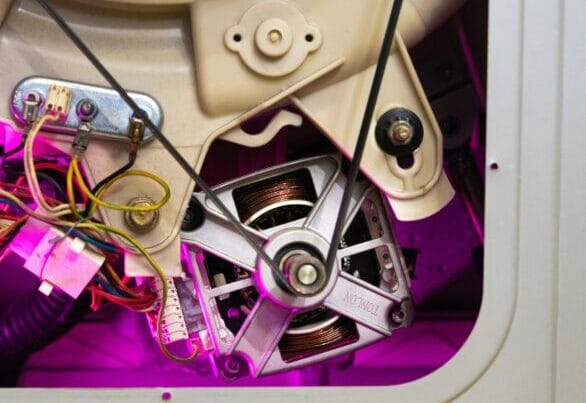

The most expensive appliance mistakes shorten usable lifespan by several years and quietly turn affordable ownership into an expensive cycle of repairs and early replacement. After enough time inside people’s kitchens and laundry rooms, it becomes obvious that machines rarely fail because they were poorly built. They fail because of how they are lived with.
The Gap Between How Appliances Are Used And How They Are Designed
Modern appliances are engineered around assumptions that most owners never see. Load limits assume reasonable distribution. Cooling paths assume unobstructed airflow. Detergent systems assume correct chemistry and dosage. Maintenance intervals assume at least occasional attention. When those assumptions are violated repeatedly, components do not fail dramatically. They wear unevenly, overheat subtly, and degrade internally until repair is no longer practical. Learn more about how modern appliances are designed in our article here.
I’ve seen two identical washers where one used lightly by a couple and the other pushed hard by a family of five, and within six years the difference in internal wear was impossible to miss. Same brand, same model, same age, completely different outcomes driven entirely by use.
From the technician side, this gap explains why two identical machines installed in the same year can age completely differently. One becomes noisy, inefficient, and unreliable well before its time. The other simply keeps running, quietly and predictably, with little more than routine service.
Why Early Failures Rarely Surprise Technicians
When an owner says an appliance “just stopped working,” there is almost always a history behind it. That history shows up in residue patterns, heat discoloration, elongated mounting holes, and fatigued bearings. These machines tell their story as soon as the cabinet comes off.
I can often predict what I am going to find before I remove the first screw. A washer that “just got loud” after years of heavy loads usually confirms bearing wear within minutes. A dishwasher that “never really cleaned well” almost always reveals a filter that has never been touched.
True factory defects do exist, but they are statistically uncommon. What technicians see far more often are components that have been overstressed for years without obvious symptoms until the moment they finally give up. Learn why poor appliance habits can cut lifespan in half in our article here.
Filters That Were Never Part Of The Routine
Filters are designed to be serviced, not ignored, yet they are treated as invisible by most owners. Dishwasher filters slowly accumulate grease and debris until circulation becomes restricted. Washer drain filters pack with lint, pet hair, and grit that increase pump load. Dryer lint escapes past screens and builds internally, long before airflow alarms appear.
I remember a service call on a relatively new dishwasher where the owner insisted the pump had failed prematurely. When I pulled the filter, it was so compacted with grease and food that water could barely pass through it. The pump itself was burnt out from months of overwork, not because it was defective, but because it had been compensating for that restriction every single cycle.
The failure does not occur when the filter clogs. It occurs months later when the pump, motor, or heating system has spent countless cycles compensating for that restriction. By the time performance complaints arise, the expensive damage is already done.
Load Size As A Chronic Source Of Mechanical Stress
Overloading is rarely an occasional mistake. It becomes a habit driven by convenience.
Washers experience bearing and suspension wear when load mass exceeds design assumptions, even if the drum physically turns. Dryers packed with dense fabrics operate at higher temperatures for longer periods, stressing motors and belts. Dishwashers filled beyond spray coverage force pumps to operate inefficiently against hydraulic resistance.
I have had more than one conversation where an owner proudly explained how much laundry they could “fit in one load,” only to be surprised later when I showed them the bearing damage inside the machine. The washer was doing exactly what it was asked to do, and wearing itself out in the process.
From a service standpoint, bearing noise, vibration complaints, and premature belt failures almost always trace back to chronic overloading rather than age alone.
Installation That Works But Is Never Quite Right
Improper installation is one of the most expensive mistakes because its effects are slow and cumulative.
A washer that is slightly out of level vibrates just enough to elongate mounting points over time. A dryer vent that is technically connected but poorly routed traps heat and moisture inside the cabinet. Drain hoses installed too low or too high force pumps to work outside their efficient range.
I have serviced machines that ran for years with no complaints, only to fail catastrophically later because a vent was crushed behind the unit or a washer rocked just enough to fatigue its frame. When I point out the installation issue, owners are often shocked because the appliance “worked fine” for so long.
These machines function normally for years, which is precisely why the damage goes unnoticed until the repair cost surprises the owner.
Chemical Stress From Detergent Misuse
Modern appliances are designed around precise chemical environments, especially high-efficiency washers and dishwashers. Excess detergent, incorrect formulations, and unnecessary additives coat internal surfaces with residue that traps moisture and interferes with sensors.
I have pulled hoses off machines where detergent residue had hardened into a chalky layer thick enough to reduce water flow significantly. In those cases, no amount of cleaning restores proper operation. The damage is already baked in.
Over time, this residue hardens inside hoses, pumps, and sumps. Seals swell, sensors misread conditions, and corrosion accelerates in places owners never see. By the time odor, leaks, or error codes appear, cleaning alone is no longer sufficient.
The Decision To Keep Running A Machine That Is Already Complaining
Appliances communicate through sound, vibration, and performance changes long before failure. A brief squeal at startup, an occasional drainage delay, or a faint burning smell are not inconveniences. They are warnings.
I once inspected a dryer that had been squealing for months, according to the owner, but still “worked fine.” By the time I opened it, the belt had nearly cut through the drum support due to misalignment. What could have been a simple belt replacement had turned into a far more expensive repair.
Continuing to operate a machine in this condition often transforms a simple repair into a complex one. From the technician side, this is where a minor part replacement escalates into multiple components being damaged because the underlying issue was allowed to persist.
Maintenance As An Afterthought Rather Than A Habit
Preventive maintenance lacks urgency, which is why it is skipped.
Cleaning condenser coils, inspecting hoses, clearing vents, and wiping seals do not feel necessary when the appliance is still functioning. Yet machines that receive even modest attention consistently outlast those that are ignored.
Some of the most reliable appliances I service are older units that have simply been kept clean and ventilated. I have customers with machines over fifteen years old that I see only occasionally, not because they never break, but because they are maintained just enough to avoid major failures.
The shortest-lived machines almost always show signs of prolonged neglect rather than sudden failure.
Appliances Treated As Furniture
Using appliances as storage platforms or work surfaces introduces stresses they were never designed to handle. Heavy items on top of machines flex cabinets and frames. Blocked ventilation raises internal temperatures. Repeated vibration against stored objects loosens fasteners and damages wiring.
I have opened control panels to find heat damage that traced directly back to blocked vents caused by items stored on top of the machine. The owner never connected the two because the appliance still turned on.
These issues rarely present as obvious damage. Instead, they manifest as alignment problems, electronic failures tied to heat, and premature wear in structural components.
The Financial Consequences In Real Terms
| Habit | Resulting Damage | Typical Added Cost |
|---|---|---|
| Ignored filters | Pump or motor failure | $250 – $600 |
| Chronic overloading | Bearing or suspension wear | $400 – $1,200 |
| Improper installation | Board or seal damage | $200 – $800 |
| Detergent misuse | Hose, seal, sensor failure | $150 – $500 |
| Ignored early symptoms | Cascading failures | $300 – $1,500 |
These figures reflect what technicians routinely see, not extreme cases.
How Technicians Recognize Preventable Failures Immediately
Any inspection begins with disconnecting power and opening the machine. From there, residue patterns, heat marks, and wear distribution quickly reveal whether the failure was accelerated by use.
Machines age honestly. When stress accumulates unevenly, it leaves visible evidence. After enough service calls, those signs become impossible to miss.
Why Owners Keep Making The Same Mistakes
Most owners are not careless. They are uninformed.
Appliances are marketed as sealed systems that require little attention. Manuals are rarely read. Warning signs are subtle. The result is misuse by assumption rather than neglect by intent.
From the service side, many early failures could be avoided with minimal education and small habit changes.
What Appliance Owners Should Understand Clearly
Appliances fail slowly, then suddenly.
The most expensive mistakes are not dramatic events but repeated decisions that seem harmless in isolation. Load size matters. Airflow matters. Chemistry matters. Small problems deserve attention.
Machines last longest when treated as mechanical systems rather than background conveniences.
Frequently Asked Questions
Do appliance habits really affect lifespan that much?
Yes. Technician experience consistently shows lifespan reductions of several years tied directly to usage and maintenance habits.
Are newer appliances less durable than older ones?
They are more efficient and precise, but less tolerant of misuse, especially with airflow, detergent, and loading.
Is maintenance necessary if the appliance works fine?
Yes. Many failures occur after long periods of silent wear without obvious symptoms.
Which mistake leads to the highest repair costs?
Chronic overloading and airflow restriction are the most expensive over time.
When does repair stop making sense?
When multiple core components are damaged and repair costs exceed the appliance’s remaining value.
How A Technician Would Reduce Long-Term Risk
A technician focuses on reducing cumulative stress through correct installation, proper loading, basic cleaning, and early intervention when symptoms appear. Any service process begins with disconnecting power and inspecting components systematically to avoid secondary damage.
Appliances do not require constant attention. They require informed use. The most expensive mistakes come from assuming they require none at all.