
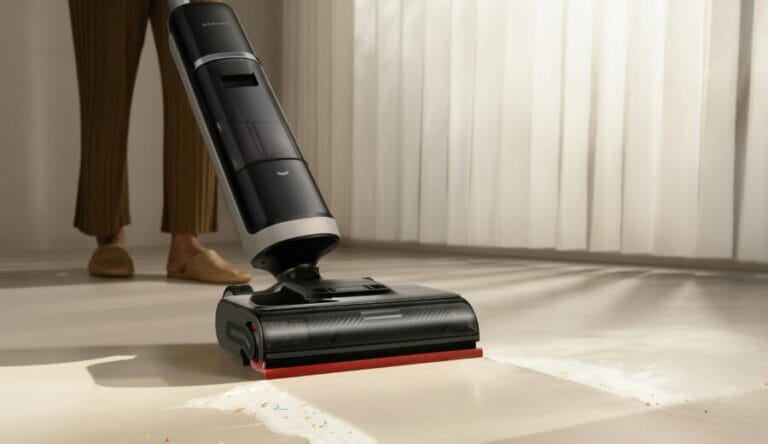

Tineco vacuums do not fail the same way traditional corded uprights do. Their most common problems stem from three design characteristics: cordless battery dependence, compact sealed brush heads, and electronics exposed to dust or moisture.
From a technician standpoint, most Tineco service calls involve performance decline rather than total failure. Runtime shortens, suction weakens, or error messages appear intermittently before the vacuum becomes unusable.
Understanding those patterns makes troubleshooting far more predictable.
Common Tineco Vacuum Issues at a Glance
Learn about the costs for these repairs in this article.
| Issue Category | Typical Symptoms | Primary Cause | Most Common Resolution |
|---|---|---|---|
| Battery degradation | Short runtime, early shutdown | Cell aging, heat | Battery replacement |
| Brush roll not spinning | Loud noise, debris left behind | Hair and bearing drag | Brush roll or head service |
| Weak suction | Poor pickup, overheating | Filter clogging, airflow loss | Filter and airpath cleaning |
| Wet dry error codes | Won’t start, stops mid-clean | Sensor contamination | Sensor cleaning or replacement |
| Charging problems | Won’t charge, flashing dock | Contact oxidation, dock faults | Contact cleaning or dock replacement |
| Control errors | Random shutdowns | Electronics heat or moisture | Board-level diagnosis |
Battery Degradation and Runtime Loss
Battery failure is the single most common Tineco issue. Most Tineco vacuums rely entirely on lithium-ion battery packs, and those batteries typically last 300 to 500 charge cycles.
Symptoms develop gradually:
- Cleaning time drops noticeably
- Vacuum shuts off while power remains on
- Multiple recharge attempts required
- Unit refuses to start on higher power modes
Technicians diagnose battery failure by observing voltage stability under load. Internal inspection always begins with disconnecting power before testing. A battery can show full charge but collapse as soon as motors engage.
Battery replacement usually restores full performance unless secondary issues exist.
Brush Roll Resistance and Head Assembly Problems
Brush roll issues are especially common on Tineco cordless and wet dry models. Hair, string, and fine debris work their way into sealed brush bearings, increasing resistance long before visible tangles appear.
As resistance increases:
- The brush motor draws higher current
- Heat builds inside the head
- Error codes or shutdowns may occur
- Pickup performance declines
On wet dry models, moisture accelerates residue buildup inside brush housings. Even self-cleaning functions do not fully prevent internal contamination over time.
Technicians remove the brush roll and inspect bearing resistance manually. If drag remains after cleaning, the brush roll or entire head assembly is replaced.
Weak Suction and Airflow Restriction
True suction motor failure is less common than airflow restriction on Tineco vacuums. Filters clog quickly due to compact airflow paths, especially in homes with fine dust or pets.
Restricted airflow causes:
- Reduced cleaning performance
- Increased motor temperature
- Battery drain acceleration
- Premature motor wear
Technicians troubleshoot suction loss by inspecting:
- Pre-filters and HEPA filters
- Dust bin seals
- Air channels between head and motor
In many cases, restoring airflow resolves the issue without replacing the motor. Continued use with clogged filters is one of the fastest ways to shorten a Tineco’s lifespan.
Wet Dry Model Sensor and Error Code Issues
Wet dry Tineco vacuums introduce a unique set of issues due to water sensors, pumps, and moisture exposure. Common symptoms include:
- Refusal to start
- Error codes mid-clean
- Incomplete cleaning cycles
- Self-cleaning failure
Moisture residue, detergent buildup, and mineral deposits interfere with sensor readings. Technicians begin by cleaning sensors and ensuring the unit fully dries between uses.
If errors persist, sensor modules may require replacement. Once moisture reaches control electronics, repair complexity increases significantly.
Charging and Docking Problems
Charging issues are often mistaken for battery failure. In reality, oxidized charging contacts are a frequent cause.
Symptoms include:
- Docking repeatedly without charging
- Flashing charge indicators
- Inconsistent charge completion
Technicians clean contacts on both the vacuum and dock, then verify dock output voltage. Internal electrical checks always require disconnecting power first.
Dock electronics failures do occur but are less common than contact-related problems.
Control Board and Electronics Failures
Electronic failures are less frequent but more disruptive. Symptoms include:
- Random shutdowns
- Failure to power on
- Inconsistent response to controls
Heat, dust intrusion, and moisture exposure are the primary contributors. Wet dry models are particularly vulnerable if not dried thoroughly.
Once control boards fail, troubleshooting shifts from mechanical isolation to electronic confirmation. These repairs are typically the most expensive.
Manufacturer vs Independent Troubleshooting
Tineco primarily supports warranty replacement rather than component-level diagnosis. During warranty periods, units are often exchanged.
Independent troubleshooting focuses on isolating failures. Batteries, brush rolls, filters, and sensors are addressed individually. This approach keeps repairs targeted and avoids unnecessary replacements.
Electronic failures late in the vacuum’s life are the main limitation for independent repair.
How Tineco Issues Are Diagnosed in Practice
Technicians usually follow a consistent diagnostic order:
- Observe runtime and error behavior
- Inspect filters, brush rolls, and wheels for resistance
- Disconnect power and test battery under load
- Verify airflow integrity
- Evaluate sensors and electronics last
This prevents replacing batteries when airflow is the real issue or condemning electronics prematurely.
Troubleshooting Takeaways for Tineco
Most Tineco vacuum problems are not sudden failures. They are the result of battery aging, increasing mechanical resistance, airflow restriction, or sensor contamination. These issues develop slowly and give warning signs well before total shutdown.
Owners who address battery health, filter maintenance, and brush roll resistance early see significantly fewer major failures, and see their units last at the higher end of the expected lifespan of 3-6 years.
The most common Tineco vacuum issues involve batteries, brush rolls, airflow restriction, and sensors, especially on wet dry models. Troubleshooting is usually straightforward when symptoms are understood and addressed systematically. With realistic expectations and consistent maintenance, Tineco vacuums perform reliably throughout their intended service life.