

| Category | Typical Range / Notes |
|---|---|
| Lifespan | 8–12 years |
| Early Wear Signs | Noise increase, mild rattle, occasional stalls |
| Late-Life Indicators | Lower housing leaks, persistent hum without spinning |
| High-Wear Factors | Hard water, fibrous or starchy foods, heavy daily use |
| When to Replace | Motor stalls frequently, chamber vibration persists, leaks appear |
How Long Do Waste King Garbage Disposals Last
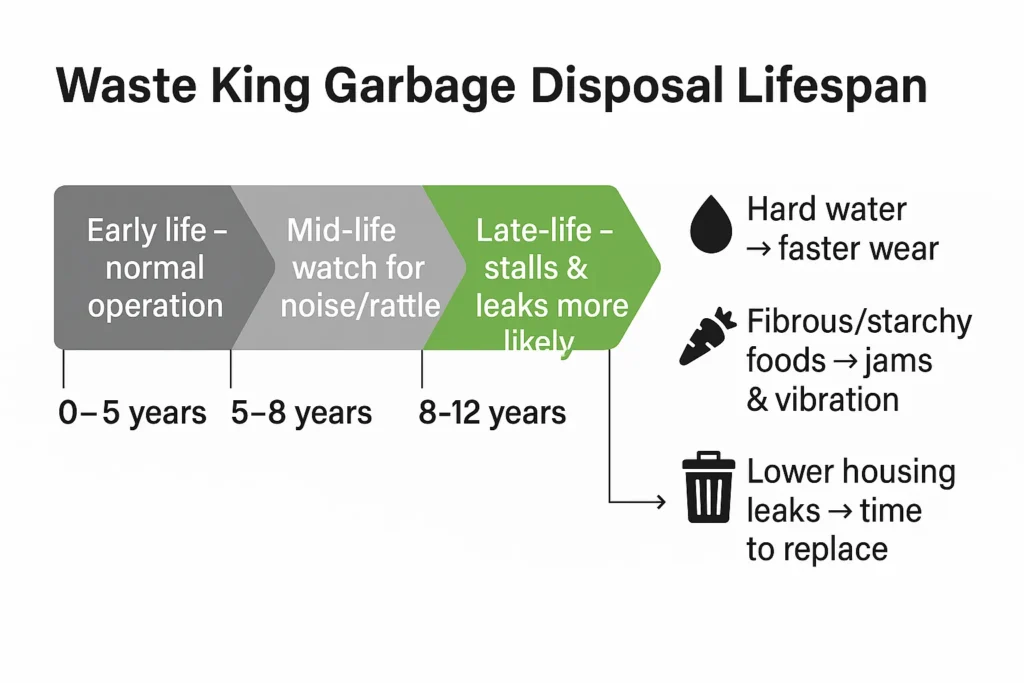
Most Waste King disposals stay in service for 8 to 12 years under normal household use, including the Legend, Knight, and L-Series families. Their motor design reaches full speed instantly, which reduces strain during startup and helps the units age more evenly. Waste King garbage disposals last a similar length to disposals from Moen, and land right in the middle for lifespan on the garbage disposal market.
Homes that run the disposal several times a day or push dense scraps through it usually see shorter lifespan ranges. Waste Kings long lifespan, energy efficiency, and build quality are why we rank it as one of the most reliable and eco-friendly garbage disposal brands.
Signs of Wear
When these units reach the back half of their life, the grinding chamber often becomes louder or develops a slight rattle at startup. Some homeowners notice occasional stalls on heavy loads even though the motor used to plow through the same material without hesitation. A few units develop leaks around the sink flange when the putty dries out, and once the lower housing begins to seep, the disposal is usually nearing the end of its usable life.
What Affects Durability
Hard water is rough on the grinding chamber, and the buildup can make the plate less balanced over time. Running large amounts of starchy or fibrous waste also drives premature wear, since these materials tend to pack tightly around the rotor. I always advise owners that a simple monthly flush with cold water while the chamber is empty helps slow this pattern. Learn more about the common issues with Waste King garbage disposals and how to fix them before they become big issues.
When Replacement Makes Sense
Repairs are worthwhile when the issue is limited to a jam, loose flange, or stuck reset. Once the motor struggles repeatedly even after clearing the chamber or water begins escaping from the lower housing, replacement is more practical than further repair. Many long-time owners say that once their older Legend or L-Series units begin humming without spinning, it usually signals the final few years of service. In a few older Knight units I have checked, the grinding plate had worn unevenly enough that the vibration never went away completely, even after clearing debris. This is a good sign that your unit needs replacement.
Cost of Repair
See the repair cost for this product.Recommended Alternatives/Replacements
This article may contain affiliate links, which allow us to earn a small commission at no extra cost to you.
Best Overall Option: InSinkErator Evolution Select
A solid choice for households that want a step up in smoothness and durability without going high-end. The disposer grinds efficiently and tends to hold its performance curve for years. Installation is simple for both new installs and replacements.
Link to purchaseBest Budget Option: Waste King L-Series
Reliable for basic grinding tasks, with motors that reach full speed quickly and clear jams less frequently than many bargain models. The units are light, which makes them easy for homeowners to mount on their own. Replacement parts are widely stocked.
Link to purchaseBest Premium Option: InSinkErator Evolution Prestige
Engineered for quiet operation and long-term stability, this model uses upgraded insulation and stronger internal hardware. It handles sustained daily use well and maintains smooth startup torque even after years of service.
Link to purchase