
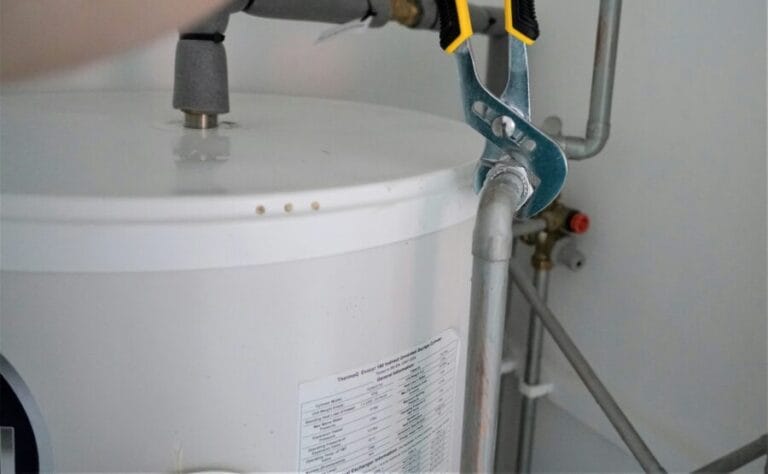

On average, homeowners spend between $150 and $900 on common repairs for water heaters, with the lower end covering electrical and valve issues and the higher end tied to control boards, gas components, or tankless system failures. The biggest cost driver is not always the part itself but the time required to safely access and test it.
Repair costs also vary by heater type. Traditional tank water heaters are usually cheaper to repair than tankless systems. Electric units tend to stay on the lower end of the range, while gas and tankless models often cost more due to safety procedures, venting, and combustion system diagnostics. To learn more about specific repairs costs by brand, check out these articles: A.O. Smith, Bosch, Bradford White, and Rheem.
Common Water Heater Repair Costs
| Problem Area | Common Symptoms | Typical Cost |
|---|---|---|
| Heating element or burner | No hot water, lukewarm output | $150–$350 |
| Thermostat failure | Water too hot or not hot enough | $120–$300 |
| Gas valve or control board | Heater will not ignite or shuts down | $250–$700 |
| T&P relief valve | Dripping pipe on side of tank | $150–$300 |
| Anode rod | Rusty water, sulfur smell | $200–$450 |
| Circulation pump (tankless) | Error codes, flow shutdowns | $300–$700 |
| Scale flushing (tankless) | Overheating shutdowns, loud noises | $200–$500 |
| Tank leak | Water pooling at base | Replacement usually required |
These numbers reflect total repair cost including parts and labor in most regions. Remote areas or emergency service calls can push pricing higher.
Symptoms That Usually Lead to Repairs
Most water heater repairs start with one of a few clear warning signs. Lukewarm water where it used to be hot often points to a heating element or thermostat failure. Popping or rumbling noises usually indicate heavy sediment buildup. Water leaking from the relief valve or connections signals pressure or valve issues. Pilot lights that will not stay lit suggest thermocouple or gas control problems. Tankless systems that shut down mid-use often show code errors related to flow, venting, or scale.
These symptoms usually show up days or weeks before a complete failure. Catching them early almost always reduces the total repair cost.
Differences in Repair Cost by Water Heater Type
Electric Tank Water Heaters
Electric tank heaters are the cheapest to repair in most cases. Heating elements and thermostats are inexpensive and easy to access. I have replaced many failed elements in under an hour with minimal diagnostic time. These units rarely require complex electrical tracing.
Gas Tank Water Heaters
Gas tank repairs cost more because combustion systems require testing for safety. Thermocouples, burners, draft sensors, and gas control valves all add diagnostic steps. A simple pilot issue might stay near the low end of the range, but a full control valve replacement pushes costs higher.
Tankless Water Heaters
Tankless systems are the most expensive to repair. Scale buildup, flow sensor failures, control boards, and ignition components require specialized tools and manufacturer-specific diagnostics. Even routine descaling costs more than most tank heater tune-ups. When boards or ignition assemblies fail, repair costs climb quickly.
Why Some Repairs Cost Much More Than Others
Parts availability plays a large role. Standard tank heaters use universal elements, thermostats, and valves that stay affordable. Tankless systems often use proprietary sensors and boards that are expensive and model-specific. Labor time also changes dramatically. A thermostat swap may take 30 minutes, while diagnosing a combustion fault on a tankless unit can take several hours.
Age matters too. Corrosion on older tanks increases disassembly time. Rusted fittings often break during removal, which adds additional parts and labor.
When Repair Makes Sense vs Replacement
Repair is usually the right choice when the heater is under about 10 years old and the failure involves elements, thermostats, valves, sensors, or descaling. Replacement becomes more practical when the tank itself is leaking, when multiple high-cost failures occur close together, or when a tankless unit requires both a major board and heat exchanger service. Check out this article to learn which brands are the most reliable and have the lowest repair costs.