
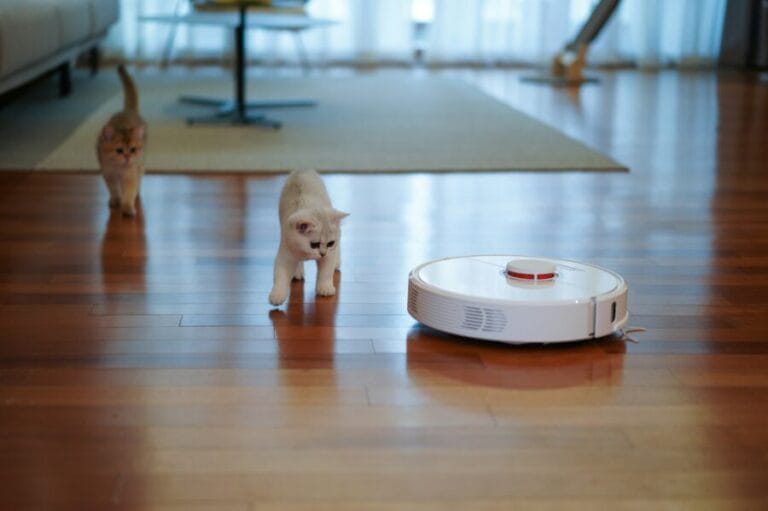

Roborock Vacuum Repair Cost Overview
Roborock robot vacuum repairs generally cost more than traditional upright vacuum repairs due to batteries, sensors, and electronic components. Most owners spend between $80 and $250 on common repairs. Higher-end repairs involving docking stations, motors, or multiple components can reach $350 to $400.
Unlike uprights, Roborock repairs often become cost-sensitive as the unit ages (typical lifespan is 4-7 years). Repair decisions are typically based on remaining battery life, navigation accuracy, and dock condition rather than a single failed part.
Average Roborock Repair Costs By Component
| Repair Item | Common Symptom | Typical Part Cost | Typical Total Cost |
|---|---|---|---|
| Battery replacement | Short runtime, frequent docking | $60 – $120 | $80 – $180 |
| Wheel module | Won’t climb, spins unevenly | $40 – $90 | $120 – $220 |
| Main brush motor | Poor debris pickup | $30 – $70 | $120 – $200 |
| Side brush motor | Missed edges, error codes | $15 – $40 | $100 – $160 |
| LiDAR sensor | Navigation errors, spinning in place | $70 – $150 | $180 – $350 |
| Charging contacts | Won’t charge consistently | $10 – $30 | $90 – $140 |
| Dock repair | Auto-empty or wash failure | $80 – $200 | $200 – $400 |
These figures reflect independent repair shops and parts availability for out-of-warranty units. Manufacturer service pricing is often higher and may involve flat-rate replacement programs instead of component-level repair. Learn more about identifying and troubleshooting these issues here.
Why Roborock Repairs Cost More Than Uprights
Robot vacuums combine mechanical, electrical, and software-dependent systems in a compact package. Diagnostics alone take longer than on traditional vacuums.
Battery handling, sensor calibration, and sealed housings increase labor time. Docking stations add pumps, fans, and electronics that do not exist on standard vacuums.
Technicians always disconnect power and isolate batteries before service to reduce electrical and thermal risk.
Battery Replacement Costs And Value
Battery replacement is the most common and most worthwhile Roborock repair.
Most batteries degrade after 3 to 5 years. Replacing the battery often restores near-original runtime and cleaning coverage.
Battery replacement usually makes sense when the robot is under 4 years old and navigation performance remains accurate. On older units, declining sensors and wheel motors may limit the benefit.
Wheel And Drive Motor Repairs
Wheel module failures are common in homes with thresholds, rugs, and pet hair.
Symptoms include drifting, repeated path correction, or inability to climb transitions. Wheel modules are replaceable but labor-intensive due to disassembly and recalibration.
When both wheel modules show wear, repair costs often approach replacement value.
LiDAR and cliff sensor issues are among the most expensive Roborock repairs.
Dust intrusion, bearing wear in the LiDAR turret, or optical sensor drift causes navigation errors rather than total failure.
Sensor repairs are rarely attempted unless the robot is relatively new. On older units, inconsistent navigation usually signals declining overall viability.
Docking Station Repair Costs
Auto-empty and mop-wash docks introduce additional repair costs.
Common failures include fan motors, pumps, valves, and communication boards. Dock repairs often cost more than repairing the robot itself.
Many owners replace the entire dock rather than repairing it once failures occur after year four.
Independent Repair Vs Manufacturer Service
Independent repair shops may handle battery, wheel, and brush motor repairs effectively. Sensor and dock repairs are less commonly offered.
Manufacturer service often uses flat-rate pricing that replaces major assemblies rather than individual components. This can simplify repair but raises cost.
When Roborock Repairs Are Worth It
Repairs usually make sense when:
- The robot is under 4 years old
- Only one major component has failed
- Navigation accuracy remains good
- Battery replacement is the primary issue
Repairs become less practical when multiple systems degrade at once or when dock repairs are required outside warranty.
Replacement is usually the better option when repair costs exceed $300 on robots older than 5 years, especially if navigation issues and battery decline appear together.
At that point, newer models offer improved mapping, battery efficiency, and dock reliability at a comparable cost.
Final Repair Cost Expectations
Most Roborock owners who pursue repairs spend between $80 and $250. High-end repairs involving sensors or docks can reach $400 but are rarely economical on older units.
Roborock vacuums are repairable, but they are not designed for indefinite service. Understanding realistic repair costs helps owners avoid sinking money into robots near the end of their practical lifespan.