

Why Dyson Cordless Vacuums Start Pulsing
On most Dyson cordless models, pulsing is a built-in protection feature. The motor controller cuts power in short bursts when airflow drops too low, which keeps the motor from overheating. Technicians often mention that this is usually caused by a clogged filter, packed cyclone, or a partial blockage somewhere in the air path rather than a bad motor.
Dyson’s own support pages for the V8 series list blocked bin inlets, dirty filters, and tool blockages as primary causes of pulsing and low suction. Owners on forums report the same pattern across Dyson V7, V8, V10, V11, V15, and Outsize cordless vacuums. The machine runs normally for a second or two, then cuts out, then restarts as soon as the trigger is pulled again.
This article is based on technician input, teardown findings, owner reports, and parts supplier data.
Click here to learn more about expected longevity for Dyson Vacuums
Troubleshooting Checklist
Most people notice the pulsing after a period of weaker suction. Fine dust in the cyclone, full bins, and neglected filters are usually in the background.
Start with three quick checks:
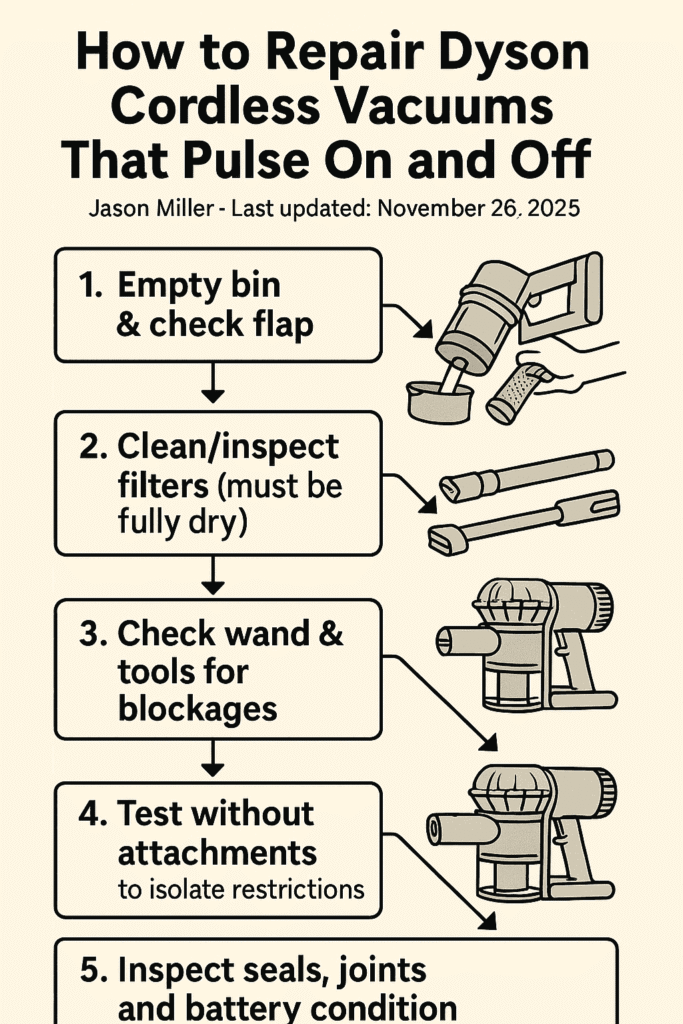
- Empty the bin completely
Take the bin off and look at the inlet flap where debris enters the cyclone. On units like the Dyson V8 Animal and Dyson V10 Absolute, fluff and hair can jam this hinge and cause the flap to stick partway closed. Dyson’s V8 troubleshooting page calls this out specifically as a cause of pulsating with low suction. - Pull out and inspect the filters
Most Dyson cordless models use a pre-motor filter near the cyclone and a post-motor filter near the handle. If either one is clogged with fine dust, airflow drops and the motor starts to surge. Dyson recommends washing filters at least once a month and fully air-drying them for 24 hours. If you reinstall a damp filter, pulsing often gets worse. - Check for obvious blockages
Remove the wand, tools, and cleaner head. Look through each piece toward a light. Any packed hair, pet fur, small toys, or gravel can be enough to trigger pulsing, especially in the narrow bends on V7 and V8 wands.
Diagnostic Steps
Once the basics are checked, you can narrow down where the restriction is happening.
| Test step | What you do | What it tells you |
|---|---|---|
| Run the motor with no wand or tools | Remove everything and pull the trigger for a few seconds | If it runs smoothly, the blockage is in the wand, head, or tools |
| Run with filters temporarily removed | Only for 3–5 seconds, never as normal use | If pulsing stops, the filters are clogged or still damp |
| Attach wand but no cleaner head | Add one section at a time | Pulsing that starts when you add the wand indicates a blockage in the tube |
| Check cleaner head separately | Look through the neck and brush cavity | Packed hair in the neck or around the brush bar is a common choke point |
Repair shops commonly see Dyson cordless vacuums that have never had the cyclone fully cleaned. Fine dust cakes inside the cyclone pack on Dyson V8 and V11 models, which is harder to spot than a simple hose clog. Several teardown videos show a thick ring of dust just above the bin that significantly restricts airflow.
Part Failures That Can Trigger Pulsing
If cleaning the air path and filters does not stop the pulsing, actual part failures become more likely. Parts suppliers note three common culprits across the cordless range:
- Worn or damaged seals around the cyclone or bin
Air leaks at these seals reduce effective suction and cause unstable airflow through the motor. - Cracked or collapsing flexible joints
On V7, V8, and V10, the flexible joints between body and wand can split over time. This does not always clog, but it can make airflow unstable enough to trigger pulsing. - Weak battery on older units
Less common, but on older Dyson V6 and V7 machines, a tired battery can cause the motor to surge or cut out under load. JustAnswer technicians frequently note that battery faults tend to show up after 4 to 5 years of heavy use and are more obvious in higher power modes.
In several units I have opened, chronic pulsing with a fully cleaned air path came down to a heavily clogged post-motor filter or a cyclone packed with ultra-fine dust that had never been washed out properly.
Learn more about other common Dyson Vacuum Repairs
Cost Expectations and When To Repair
Most fixes for a pulsing Dyson are low cost if you handle them early:
- Cleaning bin inlet, wand, and head: Free, just labor and time
- Filter replacement set: Typically in the low to mid price range for genuine or quality aftermarket parts
- Replacement wand or head assembly: Mid range cost, but usually cheaper than replacing the whole vacuum
Once you start pricing motors or full cyclone assemblies, costs climb quickly. At that level, many owners of older Dyson V7 or V8 units decide to replace the vacuum rather than rebuild it, especially if the battery is also aging. On newer machines like the Dyson V11 Torque Drive and Dyson V15 Detect, it usually makes sense to try filters, seals, and basic parts first, since the base machine still has good lifespan left.
Click here to see a more in depth cost breakdown
Model Family Notes and Preventive Tips
Pulsing and surging are most often reported on Dyson cordless stick vacuums: V6, V7, V8, V10, V11, V15, and Outsize. The underlying design is similar, so the same logic applies across the family. Uprights like the Dyson Ball Animal 2 and Dyson Ball Multi Floor 2 can also shut down for airflow issues, but they usually trip thermal cutouts rather than rapid pulsing.
Simple habits prevent most of these problems:
- Wash filters monthly, and let them dry for at least 24 hours before refitting
- Empty the bin before it reaches the max line
- Clear hair and threads from the cleaner head every few uses
- Once or twice a year, follow a full cleaning guide for the cyclone and tools
For step by step help, Dyson’s official filter care page and V8 troubleshooting guides are a good starting point. For visual walk-throughs on pulsing issues and blockage checks, detailed videos like the multi-model pulsing repair guides on YouTube are useful references.
Click here to learn about the best vacuums for low maintenance costs
I’ve been surfing online more than 3 hours today, yet I never found any interesting article like yours.
It is pretty worth enough for me. Personally, if all web owners and bloggers made good content as you
did, the net will be a lot more useful than ever before.
Wow, this paragraph is good, my younger sister is analyzing these things, therefore I am
going to convey her.