
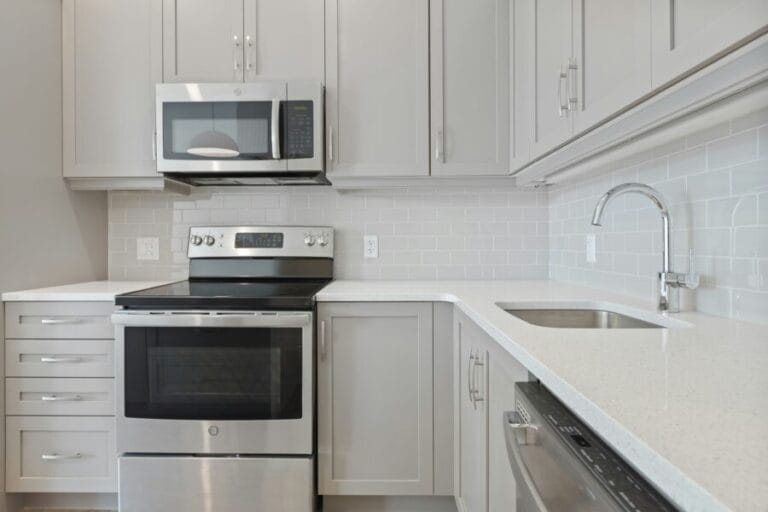

Most microwaves cost between $75 and $300 dollars to repair, depending on the problem, the location of the unit, and whether the job involves high voltage parts. Countertop models lean toward the lower end of the range because they are easier to access, while over the range units can run higher due to labor and disassembly. Over the years, I’ve seen simple door switch issues fixed cheaply and magnetron failures that ran nearly as much as a new appliance.
See more specific cost breakdowns for the following brands: Panasonic, Sharp, and Whirlpool.
Common Symptoms
Microwaves tend to telegraph their failures. A unit that runs but does not heat almost always has a high voltage issue. Intermittent shutdowns point to thermal cutouts or airflow problems. A microwave that refuses to start the moment you close the door often has misaligned latches or worn switches. Loud humming, burning smells, or a sharp ozone scent usually signal magnetron or capacitor trouble. Symptoms matter because they line up closely with repair cost brackets.
Typical Microwave Repair Costs
These figures come from service invoices, manufacturer labor guidelines, and technician reports across common brands. Countertop models will sit at the lower end of this range while built-in and over the range models will sit at the higher end.
| Symptom | Likely Failure | Typical Cost Range |
|---|---|---|
| Runs but does not heat | Magnetron, diode, or capacitor | $150 to $300 |
| Dead buttons or unresponsive controls | Keypad or control board | $120 to $250 |
| Won’t start or only starts intermittently | Door switches or latch assembly | $75 to $150 |
| Shuts off during cooking | Thermal cutoff, fan failure, or airflow restriction | $100 to $200 |
| Loud buzzing or burning smell | High voltage transformer or magnetron | $175 to $300 |
| Turntable not rotating | Motor or coupler | $75 to $125 |
| Sparks or arcing inside cavity | Waveguide cover or interior damage | $80 to $180 |
Labor Costs
Labor drives a large portion of the cost. Over the range models take longer to pull down and reinstall, so even a simple switch job may be higher than the same repair on a countertop unit. Replacement parts also vary in quality. A high grade magnetron is far more expensive than a simple door switch, and the labor is riskier because the tech has to handle the high voltage system safely.
Cavity damage and arcing repairs depend on how severe the carbon scoring is. If the interior coating is too far gone, many companies recommend replacement because it cannot be restored safely. Control boards tend to fall somewhere in the middle; many are repairable, but some require full board replacement, which raises cost on premium built in models.
When to Repair
Simple mechanical issues on over the range or built in microwaves are usually worth fixing. Switches, latches, fans, and thermal cutouts are inexpensive and often extend the life of the unit by several years. Once the magnetron, high voltage transformer, or control board fail on a microwave older than eight to ten years, most owners start comparing repair costs to replacement. Countertop units especially are often replaced once repairs climb past the 150 mark. See our guide for how long you microwave should last.
When to Replace
If the microwave is showing multiple symptoms, such as weak heating plus intermittent shutdowns, it usually means several components are wearing down at once. High end built in units are the exception because replacing them can be costly. For everything else, once the repair creeps near half the price of a new microwave, replacement typically wins.
Looking to replace your microwave? See our guide for the most durable microwaves.
FAQ
Is it worth repairing a microwave that does not heat?
It depends on the model. If it is an over the range or built in unit, repairing a failed diode or capacitor may be cost effective. If the magnetron is bad and the unit is older, replacement is usually cheaper.
Why does my microwave shut off mid cycle?
Most of the time the thermal fuse is tripping due to overheating. Blocked vents, a failed cooling fan, or a weak magnetron can all cause excess heat.
What is the cheapest microwave repair?
Door switch replacements are usually the least expensive. They solve many no start or intermittent start issues.
Can a sparking microwave be repaired?
Yes, if the problem is a damaged waveguide cover or carbon buildup. If the cavity metal is burned through or peeling, replacement is the safer option.